Trading

·

April 21, 2026

Gold-backed crypto tokens: how to compare and buy tokenized gold

Carol Yumi

Compare gold-backed crypto tokens by backing, issuer, liquidity, and custody. See how PAXG, XAUT, and others stack up on Matcha's Commodities table, and swap them without leaving the page.

Gold-backed crypto tokens let you hold exposure to physical gold as an onchain asset. The top tokens are backed 1:1 by allocated gold bars, issued by regulated companies with published audits, and have enough onchain liquidity for you to exit your position when you need to. Matcha's Commodities table shows them side by side: market cap, Liquidity Score, holders. And you can swap right there!

What are tokenized gold tokens?

Tokenized gold tokens are crypto tokens backed by physical gold. Each token represents a claim on a specific amount of gold held in custody, typically one fine troy ounce per token, stored in audited vaults.

The market has grown fast. Tokenized commodities rose 22.8% in January 2026 alone, with PAXG and XAUT both hitting record market caps as gold crossed $5,000 per ounce. Paxos alone has tokenized over 500,000 ounces of gold on Ethereum (more than 15 metric tons). Gold itself has climbed from $3,000 to nearly $5,000 per ounce over the past twelve months.

Data through Q1 2026

Tokenized gold growth, Q2 2024 – Q1 2026

Quarterly trading volume and market cap. Hover any bar or dot for details.

$5.6B
Market cap in Q1 2026 — a 5x climb from $1.1B in Q2 2024
$126B
Q4 2025 trading volume — surpassed every U.S. gold ETF except GLD
1,300%
YoY growth in Q1 2026 trading volume vs. Q1 2025

Trading volume vs. market cap

Volume in $B (bars) · Market cap in $B (line)

$150B $120B $90B $60B $30B $0 $7B $5B $3B $1B $2.4B $5.0B $8.0B $12B $19B $28B $126B $82B ↓ from peak, still +1,300% YoY $1.1B $1.3B $1.6B $1.8B $2.2B $2.9B $4.4B $5.6B Q2 '24 Q3 '24 Q4 '24 Q1 '25 Q2 '25 Q3 '25 Q4 '25 Q1 '26
Trading volume
Market cap
Market cap climbed 5x from $1.1B to $5.6B as gold broke $5,000/oz. The bigger story is volume: Q4 2025 hit $126B, surpassing every U.S. gold ETF except GLD. Q1 2026 pulled back to $82B — still 1,300% YoY and enough to rank tokenized gold as the fourth-largest gold investment vehicle globally.

Source: CoinDesk

Two tokens dominate: PAXG and XAUT together account for roughly 97% of the tokenized gold market. Other gold tokens exist, but they typically have smaller market caps, fewer holders, and in many cases no verifiable audit trail. If you're comparing gold tokens, these two are the starting point.
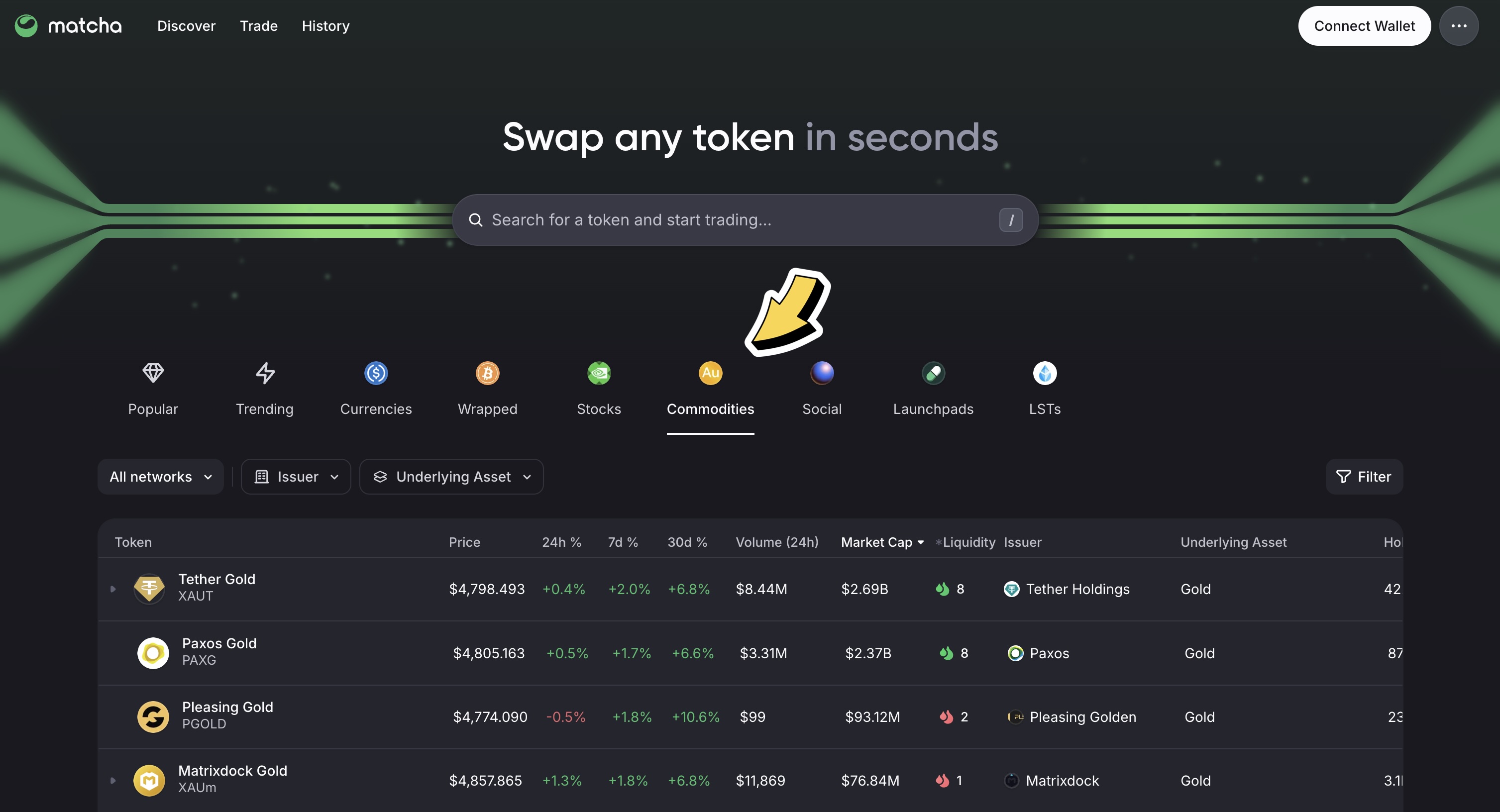
Matcha Commodities table comparing PAXG and XAUT by market cap, Liquidity Score, and holders

PAXG (Paxos Gold) has a ~$2.4 billion market cap. Issued by Paxos Trust Company, regulated by the New York State Department of Financial Services (NYDFS), each token represents one fine troy ounce of London Good Delivery gold stored in LBMA-accredited vaults. Monthly third-party attestations confirm the backing. Supply recently crossed 500,000 PAXG on Ethereum: over 15 metric tons of tokenized gold.

XAUT (Tether Gold) has a ~$2.9 billion market cap. Issued by TG Commodities Limited (a Tether affiliate) and backed by gold in Swiss vaults. XAUT tends to carry higher trading volume, partly because it's more heavily traded in Asian markets against USDT. On weekends, XAUT often reprices faster, reflecting global sentiment while Western markets are offline.

Why tokenized gold matters

Gold has been a store of value for thousands of years. Tokenized versions remove the friction of owning and trading it.

No vaults, no minimums. Physical gold requires storage, insurance, and typically a minimum purchase in the thousands of dollars. A tokenized gold token lets you hold a fraction of an ounce in your wallet.

Trade 24/7, including weekends. Traditional markets close on weekends. Tokenized gold doesn't. During the March 2026 geopolitical escalation, PAXG and XAUT continued trading while spot markets were shut, giving traders a way to react to breaking news in real time rather than waiting for Monday's open.

Use gold in DeFi. Gold tokens are ERC-20s. They work as collateral, in liquidity pools, and across DeFi protocols. Something a bar in a vault can't do.

But not all gold tokens carry the same risk. Some are backed 1:1 by allocated bars in audited vaults. Others claim gold backing with no published proof. The issuer, custody setup, audit schedule, and onchain liquidity all vary. Those differences determine whether you're holding actual gold exposure or a token with "gold" in the name.

What to check before you trade

Is the gold actually there?

This is the question that separates real gold tokens from fakes. A properly backed token has allocated physical gold in an audited vault, with regular third-party attestations confirming the amount matches the circulating supply.

Paxos publishes monthly attestation reports from an independent auditor, and you can look up a specific PAXG token's serial number and gold bar association through their verification tool. XAUT publishes periodic reports from an independent auditor on its Swiss-vaulted reserves.

Tokens without published attestations are a fundamentally different risk category. Check the issuer's website for the latest report. If you can't find one, that tells you what you need to know.

Who is the issuer and how are they regulated?

Your issuer is your counterparty. Bankruptcy, regulatory action, or fraud could make your token worthless regardless of any gold that supposedly backs it.

Paxos Trust Company operates under NYDFS supervision as a New York-regulated trust company. Capital reserve requirements, regular examinations, and consumer protection standards all apply. PAXG holders legally own the underlying gold.

TG Commodities Limited, the XAUT issuer, is a Tether affiliate. It stores gold in Swiss vaults and publishes attestations, but operates under a different regulatory framework than Paxos. The trust structure and legal ownership model differ between the two.

For any gold token, ask three questions:

  • Who issued it?
  • Where are they incorporated?
  • What regulator oversees them?

No clear answers? The risk you’re taking goes beyond gold price volatility.
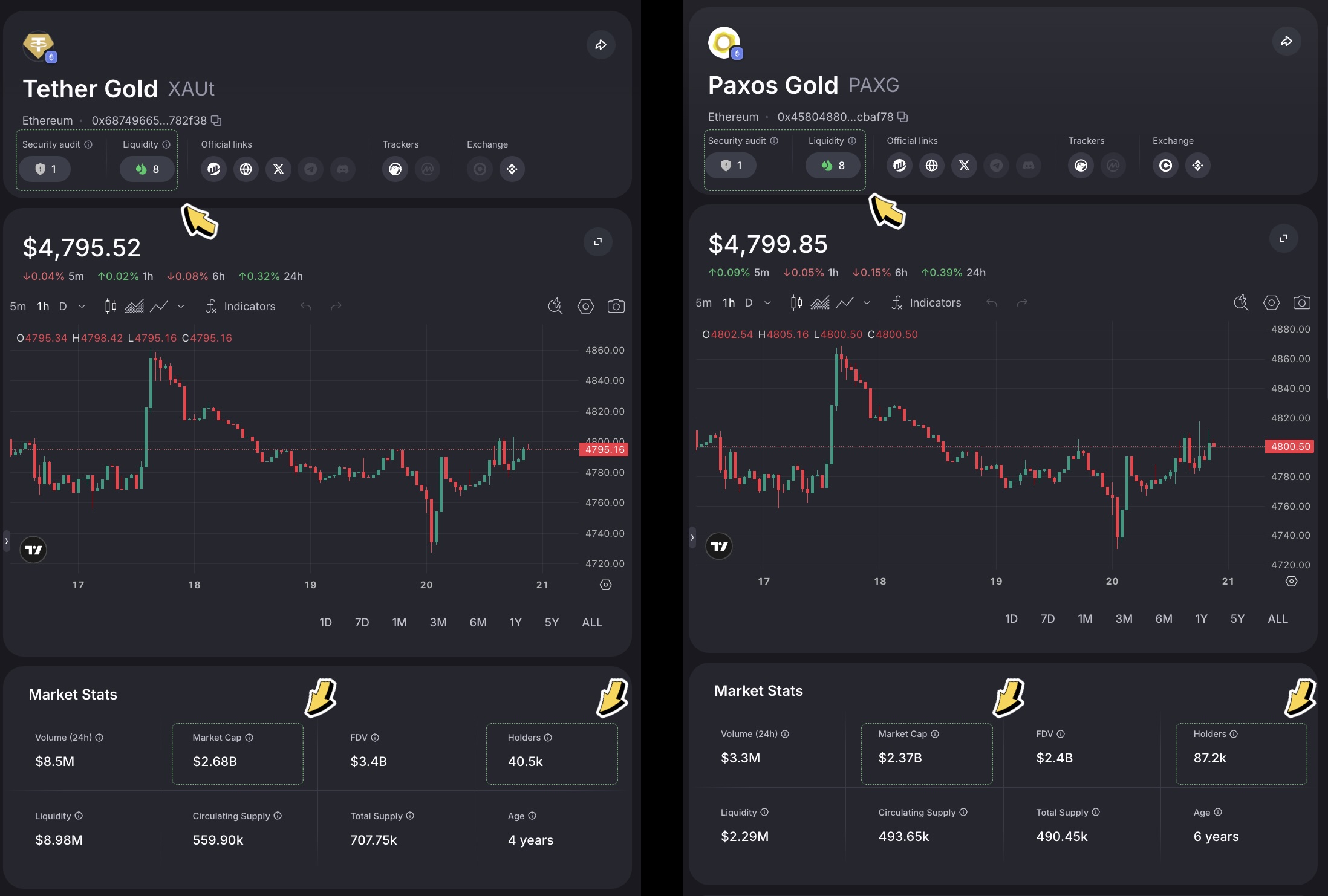
PAXG token page on Matcha showing market cap, holders, and token details

Can you redeem for physical gold?

PAXG and XAUT offer physical redemption, but the minimum thresholds are high. PAXG requires one London Good Delivery bar (roughly 430 troy ounces). XAUT offers redemption in Switzerland with its own minimums.

In practice, most traders holding gold tokens exit via secondary markets rather than requesting physical delivery. The point of the token is gold exposure without the physical logistics. That means your exit depends on onchain liquidity, not a vault in London.

Check the liquidity

Gold tokens live on specific chains, and liquidity profiles can vary sharply depending on where you trade.

PAXG lives primarily on Ethereum, where it has the deepest DEX pools. XAUT is also on Ethereum. Some gold tokens have bridged to other chains, but pool depth there is often a fraction of mainnet.

Tokenized gold tends to attract larger position sizes. If you're trading $50,000 worth, the difference between a chain with deep liquidity and one with shallow pools could mean significant slippage. The Liquidity Score on Matcha shows how much you can swap with less than 2.5% price impact. A higher score means deeper pools and cleaner execution for your size.

Filter the Commodities table by chain and sort by Liquidity Score. Same token, different chain: one might show 8/10 while another shows 2/10. Your chain choice affects execution quality directly.

One more thing: does the Liquidity Score make sense relative to the market cap? A gold token with a large market cap but near-zero DEX liquidity could mean most of the supply sits on centralized exchanges or in cold storage. That doesn't help if you need to swap onchain. For more on reading these signals, see Check 3 and Check 5 in our research guide.
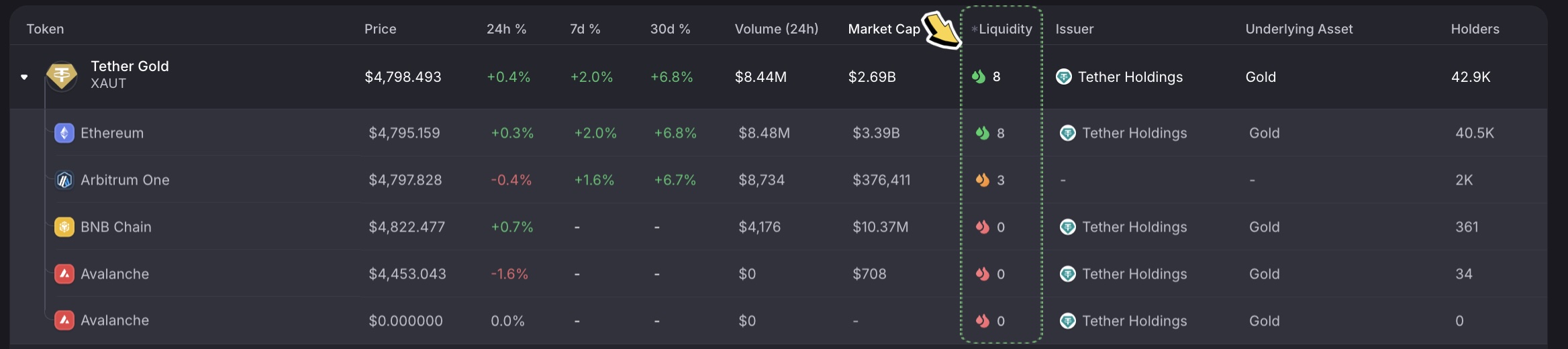
Comparing gold token liquidity across chains on Matcha's Commodities table

Check the security audit

Matcha flags risky smart contract functions on token pages, powered by GoPlus security data. Before you swap any gold token, check the token page for warnings. A legitimate gold token from a regulated issuer should show no major security flags. If you see transfer restrictions, blacklist functions, or other red flags, investigate before trading.

How to trade tokenized gold on Matcha

Once you've checked the backing, the issuer, the liquidity, and the security flags, you're ready to trade.

Head to the Commodities table. Gold-backed tokens are listed with their market cap, Liquidity Score, holders, and price action in one view. Sort by Liquidity Score to find where execution is deepest.

Click through to a token page for the full picture: market cap, holder count, price chart, and security flags. Confirm the Liquidity Score supports your trade size on the chain you're using.

Swap interface is on the same page. Select your input token, enter the amount, and Matcha checks 370+ liquidity sources for competitive pricing. No tab-switching, no copy-pasting contract addresses into a separate DEX.
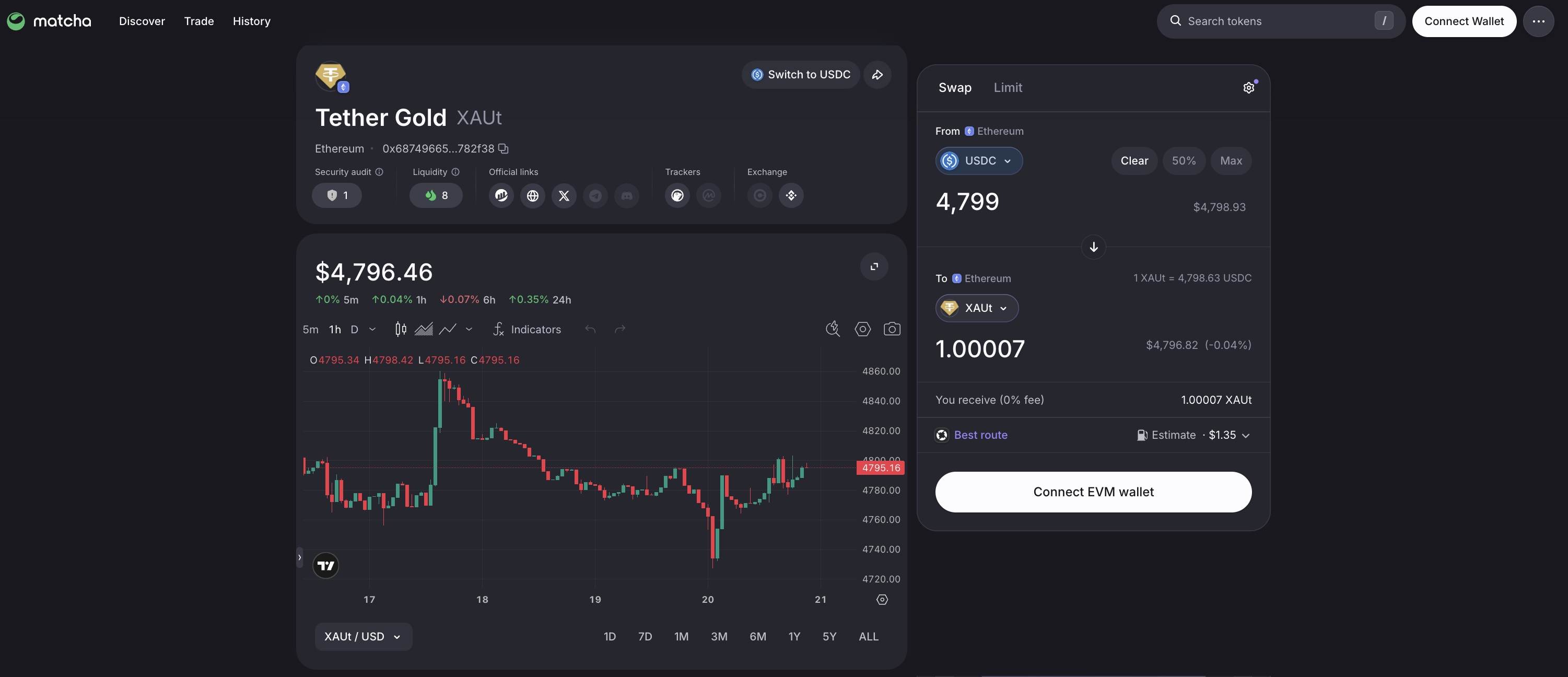
Swapping USDC for XAUT on Matcha's token page

Frequently asked questions

Are gold tokens backed 1:1 by physical gold?

The major ones are. PAXG is backed 1:1 by gold bars in LBMA vaults, with monthly attestations from a third-party auditor. XAUT is backed 1:1 by gold in Swiss vaults. Not all gold tokens follow this model — always check the issuer and whether independent audits are published.

Can I redeem a gold token for physical gold?

Most traders swap gold tokens on secondary markets rather than redeeming for physical delivery. PAXG holders can redeem for physical bars, but the minimum is roughly 430 oz (one London Good Delivery bar). XAUT offers redemption in Switzerland with its own thresholds.

How do I compare gold tokens by liquidity?

Sort the Commodities table by Liquidity Score. A higher score means deeper DEX pools and less price impact on larger trades. Two tokens with similar market caps can have very different liquidity depth — the score makes that difference visible.

What happens to my gold token if gold prices drop?

Your token's value tracks the spot price of gold. If gold falls 5%, your gold token drops roughly 5%. Gold tokens give you onchain exposure to the commodity — they don't protect against price declines. The backing and custody structure remain the same regardless of price movement.

More from Matcha

Contents
Subscribe to our newsletter
By submitting you're confirming that you agree with our Terms and Conditions.
Yay! You’re signed up.
Oops! Something went wrong, but it's not your fault.
Trading

·

April 21, 2026

Gold-backed crypto tokens: how to compare and buy tokenized gold

Gold-backed crypto tokens — illustration of a gold coin with sparkle accents on a light gray background with abstract circular line patterns

Compare gold-backed crypto tokens by backing, issuer, liquidity, and custody. See how PAXG, XAUT, and others stack up on Matcha's Commodities table, and swap them without leaving the page.

Gold-backed crypto tokens let you hold exposure to physical gold as an onchain asset. The top tokens are backed 1:1 by allocated gold bars, issued by regulated companies with published audits, and have enough onchain liquidity for you to exit your position when you need to. Matcha's Commodities table shows them side by side: market cap, Liquidity Score, holders. And you can swap right there!

What are tokenized gold tokens?

Tokenized gold tokens are crypto tokens backed by physical gold. Each token represents a claim on a specific amount of gold held in custody, typically one fine troy ounce per token, stored in audited vaults.

The market has grown fast. Tokenized commodities rose 22.8% in January 2026 alone, with PAXG and XAUT both hitting record market caps as gold crossed $5,000 per ounce. Paxos alone has tokenized over 500,000 ounces of gold on Ethereum (more than 15 metric tons). Gold itself has climbed from $3,000 to nearly $5,000 per ounce over the past twelve months.

Data through Q1 2026

Tokenized gold growth, Q2 2024 – Q1 2026

Quarterly trading volume and market cap. Hover any bar or dot for details.

$5.6B
Market cap in Q1 2026 — a 5x climb from $1.1B in Q2 2024
$126B
Q4 2025 trading volume — surpassed every U.S. gold ETF except GLD
1,300%
YoY growth in Q1 2026 trading volume vs. Q1 2025

Trading volume vs. market cap

Volume in $B (bars) · Market cap in $B (line)

$150B $120B $90B $60B $30B $0 $7B $5B $3B $1B $2.4B $5.0B $8.0B $12B $19B $28B $126B $82B ↓ from peak, still +1,300% YoY $1.1B $1.3B $1.6B $1.8B $2.2B $2.9B $4.4B $5.6B Q2 '24 Q3 '24 Q4 '24 Q1 '25 Q2 '25 Q3 '25 Q4 '25 Q1 '26
Trading volume
Market cap
Market cap climbed 5x from $1.1B to $5.6B as gold broke $5,000/oz. The bigger story is volume: Q4 2025 hit $126B, surpassing every U.S. gold ETF except GLD. Q1 2026 pulled back to $82B — still 1,300% YoY and enough to rank tokenized gold as the fourth-largest gold investment vehicle globally.

Source: CoinDesk

Two tokens dominate: PAXG and XAUT together account for roughly 97% of the tokenized gold market. Other gold tokens exist, but they typically have smaller market caps, fewer holders, and in many cases no verifiable audit trail. If you're comparing gold tokens, these two are the starting point.

Matcha Commodities table comparing PAXG and XAUT by market cap, Liquidity Score, and holders

PAXG (Paxos Gold) has a ~$2.4 billion market cap. Issued by Paxos Trust Company, regulated by the New York State Department of Financial Services (NYDFS), each token represents one fine troy ounce of London Good Delivery gold stored in LBMA-accredited vaults. Monthly third-party attestations confirm the backing. Supply recently crossed 500,000 PAXG on Ethereum: over 15 metric tons of tokenized gold.

XAUT (Tether Gold) has a ~$2.9 billion market cap. Issued by TG Commodities Limited (a Tether affiliate) and backed by gold in Swiss vaults. XAUT tends to carry higher trading volume, partly because it's more heavily traded in Asian markets against USDT. On weekends, XAUT often reprices faster, reflecting global sentiment while Western markets are offline.

Why tokenized gold matters

Gold has been a store of value for thousands of years. Tokenized versions remove the friction of owning and trading it.

No vaults, no minimums. Physical gold requires storage, insurance, and typically a minimum purchase in the thousands of dollars. A tokenized gold token lets you hold a fraction of an ounce in your wallet.

Trade 24/7, including weekends. Traditional markets close on weekends. Tokenized gold doesn't. During the March 2026 geopolitical escalation, PAXG and XAUT continued trading while spot markets were shut, giving traders a way to react to breaking news in real time rather than waiting for Monday's open.

Use gold in DeFi. Gold tokens are ERC-20s. They work as collateral, in liquidity pools, and across DeFi protocols. Something a bar in a vault can't do.

But not all gold tokens carry the same risk. Some are backed 1:1 by allocated bars in audited vaults. Others claim gold backing with no published proof. The issuer, custody setup, audit schedule, and onchain liquidity all vary. Those differences determine whether you're holding actual gold exposure or a token with "gold" in the name.

What to check before you trade

Is the gold actually there?

This is the question that separates real gold tokens from fakes. A properly backed token has allocated physical gold in an audited vault, with regular third-party attestations confirming the amount matches the circulating supply.

Paxos publishes monthly attestation reports from an independent auditor, and you can look up a specific PAXG token's serial number and gold bar association through their verification tool. XAUT publishes periodic reports from an independent auditor on its Swiss-vaulted reserves.

Tokens without published attestations are a fundamentally different risk category. Check the issuer's website for the latest report. If you can't find one, that tells you what you need to know.

Who is the issuer and how are they regulated?

Your issuer is your counterparty. Bankruptcy, regulatory action, or fraud could make your token worthless regardless of any gold that supposedly backs it.

Paxos Trust Company operates under NYDFS supervision as a New York-regulated trust company. Capital reserve requirements, regular examinations, and consumer protection standards all apply. PAXG holders legally own the underlying gold.

TG Commodities Limited, the XAUT issuer, is a Tether affiliate. It stores gold in Swiss vaults and publishes attestations, but operates under a different regulatory framework than Paxos. The trust structure and legal ownership model differ between the two.

For any gold token, ask three questions:

  • Who issued it?
  • Where are they incorporated?
  • What regulator oversees them?

No clear answers? The risk you’re taking goes beyond gold price volatility.

PAXG token page on Matcha showing market cap, holders, and token details

Can you redeem for physical gold?

PAXG and XAUT offer physical redemption, but the minimum thresholds are high. PAXG requires one London Good Delivery bar (roughly 430 troy ounces). XAUT offers redemption in Switzerland with its own minimums.

In practice, most traders holding gold tokens exit via secondary markets rather than requesting physical delivery. The point of the token is gold exposure without the physical logistics. That means your exit depends on onchain liquidity, not a vault in London.

Check the liquidity

Gold tokens live on specific chains, and liquidity profiles can vary sharply depending on where you trade.

PAXG lives primarily on Ethereum, where it has the deepest DEX pools. XAUT is also on Ethereum. Some gold tokens have bridged to other chains, but pool depth there is often a fraction of mainnet.

Tokenized gold tends to attract larger position sizes. If you're trading $50,000 worth, the difference between a chain with deep liquidity and one with shallow pools could mean significant slippage. The Liquidity Score on Matcha shows how much you can swap with less than 2.5% price impact. A higher score means deeper pools and cleaner execution for your size.

Filter the Commodities table by chain and sort by Liquidity Score. Same token, different chain: one might show 8/10 while another shows 2/10. Your chain choice affects execution quality directly.

One more thing: does the Liquidity Score make sense relative to the market cap? A gold token with a large market cap but near-zero DEX liquidity could mean most of the supply sits on centralized exchanges or in cold storage. That doesn't help if you need to swap onchain. For more on reading these signals, see Check 3 and Check 5 in our research guide.

Comparing gold token liquidity across chains on Matcha's Commodities table

Check the security audit

Matcha flags risky smart contract functions on token pages, powered by GoPlus security data. Before you swap any gold token, check the token page for warnings. A legitimate gold token from a regulated issuer should show no major security flags. If you see transfer restrictions, blacklist functions, or other red flags, investigate before trading.

How to trade tokenized gold on Matcha

Once you've checked the backing, the issuer, the liquidity, and the security flags, you're ready to trade.

Head to the Commodities table. Gold-backed tokens are listed with their market cap, Liquidity Score, holders, and price action in one view. Sort by Liquidity Score to find where execution is deepest.

Click through to a token page for the full picture: market cap, holder count, price chart, and security flags. Confirm the Liquidity Score supports your trade size on the chain you're using.

Swap interface is on the same page. Select your input token, enter the amount, and Matcha checks 370+ liquidity sources for competitive pricing. No tab-switching, no copy-pasting contract addresses into a separate DEX.

Swapping USDC for XAUT on Matcha's token page

Frequently asked questions

Are gold tokens backed 1:1 by physical gold?

The major ones are. PAXG is backed 1:1 by gold bars in LBMA vaults, with monthly attestations from a third-party auditor. XAUT is backed 1:1 by gold in Swiss vaults. Not all gold tokens follow this model — always check the issuer and whether independent audits are published.

Can I redeem a gold token for physical gold?

Most traders swap gold tokens on secondary markets rather than redeeming for physical delivery. PAXG holders can redeem for physical bars, but the minimum is roughly 430 oz (one London Good Delivery bar). XAUT offers redemption in Switzerland with its own thresholds.

How do I compare gold tokens by liquidity?

Sort the Commodities table by Liquidity Score. A higher score means deeper DEX pools and less price impact on larger trades. Two tokens with similar market caps can have very different liquidity depth — the score makes that difference visible.

What happens to my gold token if gold prices drop?

Your token's value tracks the spot price of gold. If gold falls 5%, your gold token drops roughly 5%. Gold tokens give you onchain exposure to the commodity — they don't protect against price declines. The backing and custody structure remain the same regardless of price movement.

More from Matcha

Subscribe for an instantly better inbox

By submitting you're confirming that you agree with our Terms and Conditions.
Yay! You’re signed up.
Oops! Something went wrong while submitting the form.