.jpg)

A 5-step checklist to research cryptocurrencies before buying a token
How to research a crypto token before you buy
To research a crypto token before you buy, check five things: verify it's the real token (not a counterfeit), read the fundamentals, analyze liquidity, and confirm you can actually exit the position later. Matcha lets you do all five checks and trade in one place.
So you found a token. Maybe it came up in a Telegram group, someone posted about it on X, or you spotted it trending somewhere. Now you want to buy it, but how do you finish the job without losing money?
Researching a token means confirming it's legitimate and checking whether the onchain conditions actually support your trade. Is it the real one, or a counterfeit with the same name? Which chain should you buy on? Is there enough liquidity for you to exit later?
Most people skip these questions. They copy-paste a token name into whatever DEX they use and swap. Or they open a screener and get hit with a wall of flashing numbers, ads, promoted tokens, and noise that makes it harder to think clearly, not easier.
Every token page on Matcha shows you the signals that actually matter across 45 million tokens on 17 chains, and the swap interface is right there when you're ready. For established projects, you may also want to read the whitepaper, look into who's building it, and review the tokenomics (supply schedule, vesting, distribution). For a launchpad token that went live 10 minutes ago, those things may not exist yet, and the onchain signals below are all you have.
This guide focuses on five onchain checks you can do on Matcha in under a minute.
What you can research on Matcha
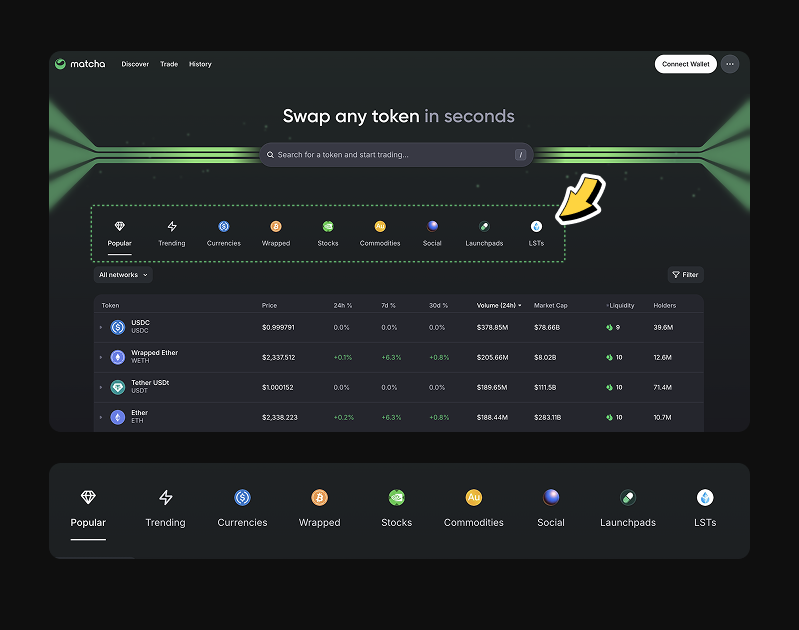
Matcha's Discovery Table organizes tokens into categories you can browse and filter:
- Currencies: Stablecoins like USDC, USDT, DAI, and dozens more, compared by issuer, backing, and cross-chain liquidity
- Stocks: tokenized equities like Tesla, Nvidia, and Apple, tradeable 24/7 onchain via xStocks
- Commodities: gold-backed tokens (PAXG, XAUT), silver, and other tokenized real-world assets
- LSTs: liquid staking tokens like stETH, JitoSOL, and rETH, compared by yield and liquidity depth
- Launchpads: tokens from Pump.fun, Virtuals, Clanker, and other launchpad platforms
- Social: creator coins and social tokens from platforms like Zora and Base App
- Wrapped Assets: wrapped tokens are versions of tokens adapted to work across different chains and standards
You don't have to start from a category. If you already have a token in mind, you can search by name or paste the contract address directly. Matcha indexes over 45 million tokens. If a pool exists, the token will be there.
The five checks before you buy
Have a token you want to buy? Here's how to verify it in under a minute.
Check 1: is this the right token?
This is the most important check, and the one people skip most often. Dozens of counterfeit tokens share the same name and ticker as legitimate projects. Some are honeypots. Some are impersonators riding a trending name.
Token pages on Matcha flag risky smart contract functions (powered by GoPlus security data) so you can spot red flags before you swap. Check the contract address against the official project source, or verify it on a block explorer like Etherscan.
If you pasted a contract address from the project's official site or announcement, you're already looking at the right page. If you searched by name and multiple results appeared, you can often verify it by looking for the highest holder count and deepest liquidity. Counterfeits rarely have either.
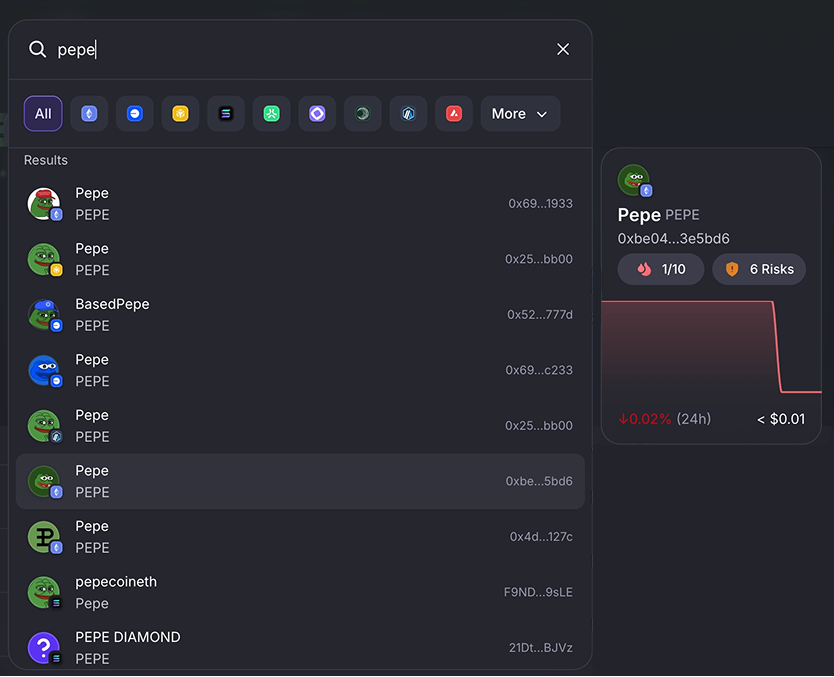
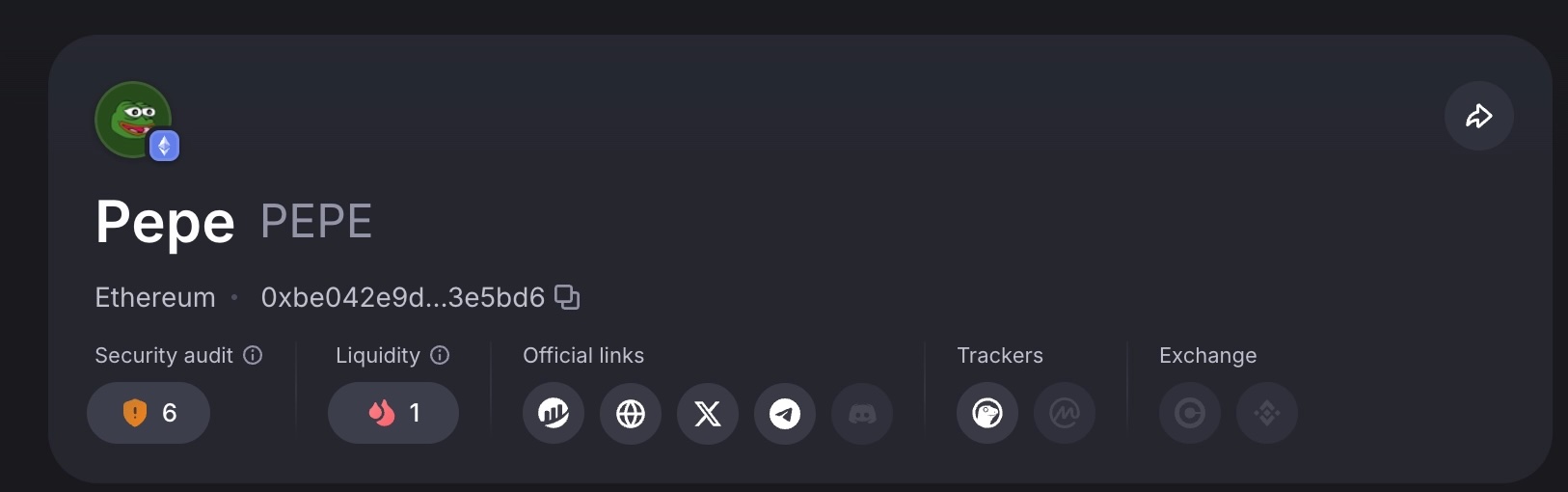
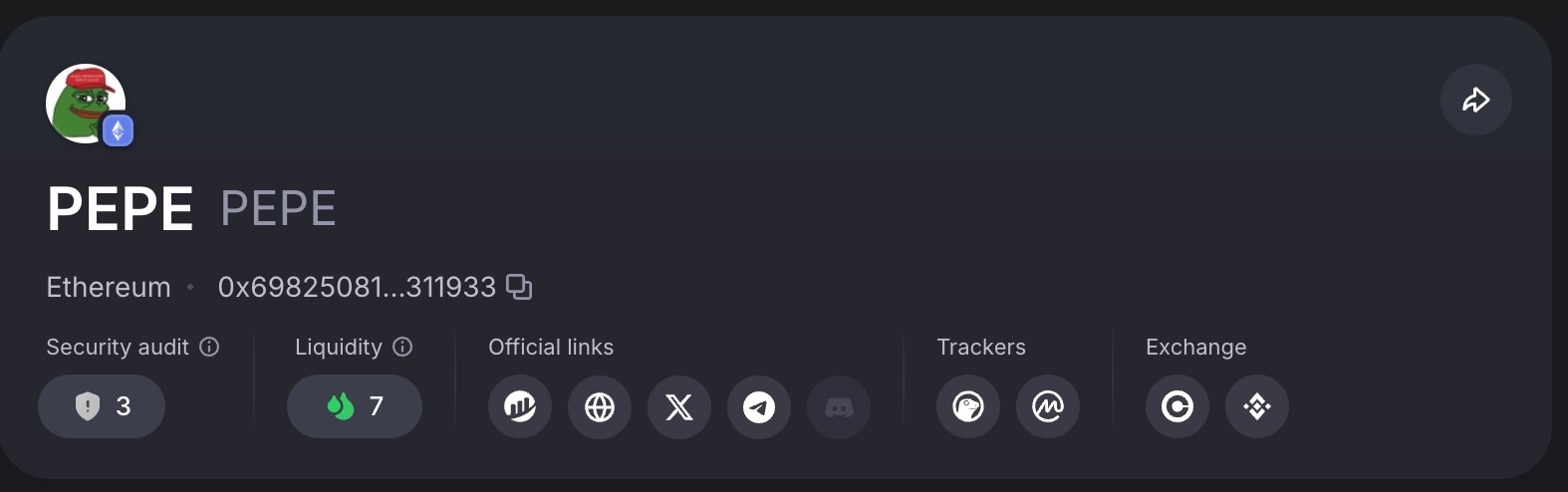
The check: Does the contract address match the one from the official project website or channels? Does the token page show any security warnings? If you searched by name, is this the version with real holders and real liquidity, or one of the fakes?
Check 2: what do the fundamentals look like?
Once you've confirmed you're looking at the right token, read the numbers.
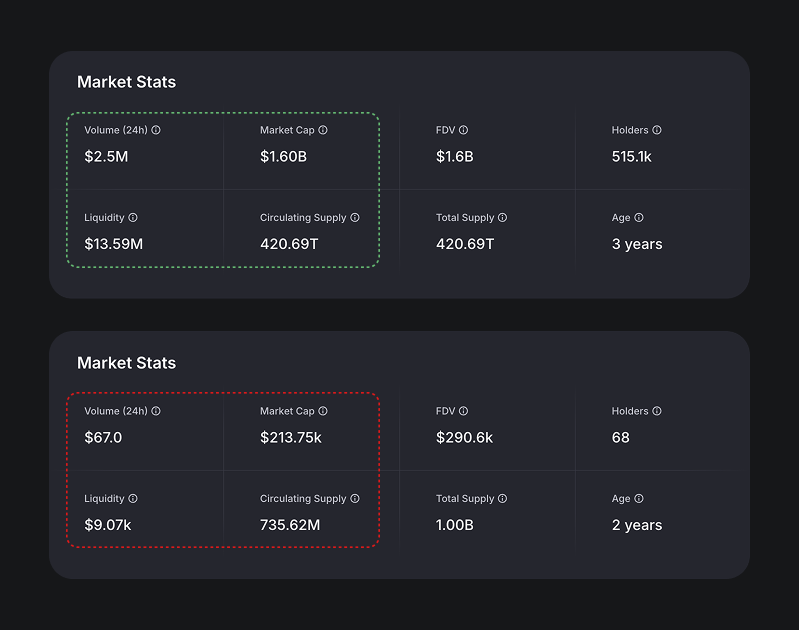
Market cap tells you the total value of circulating supply. A $500M market cap token is a very different risk profile from a $50K one, but market cap alone needs context from the other signals.
Holders shows how many unique wallet addresses hold it. Something with a $10M market cap and only a handful of holders is concentrated in very few hands. Tens of thousands of holders signals broader distribution, making it harder for any single wallet to manipulate the price.
Price action on Matcha's charts gives you the full picture: candlesticks, line charts, drawing tools, volume indicators, and timeframes down to 1-minute ticks. You can see whether the price has been climbing with growing volume, or whether it spiked this morning on a handful of trades.
The check: Does the market cap make sense relative to holder count? Is the price action organic or a single spike? Is the holder base broad or concentrated?
Check 3: which chain has the deepest liquidity?
A single asset often exists on multiple chains, and the liquidity profile can look completely different on each one. Liquidity determines your execution quality. A $500 swap on a thin pool might be fine. A $50,000 swap on that same pool could cost you hundreds in slippage.
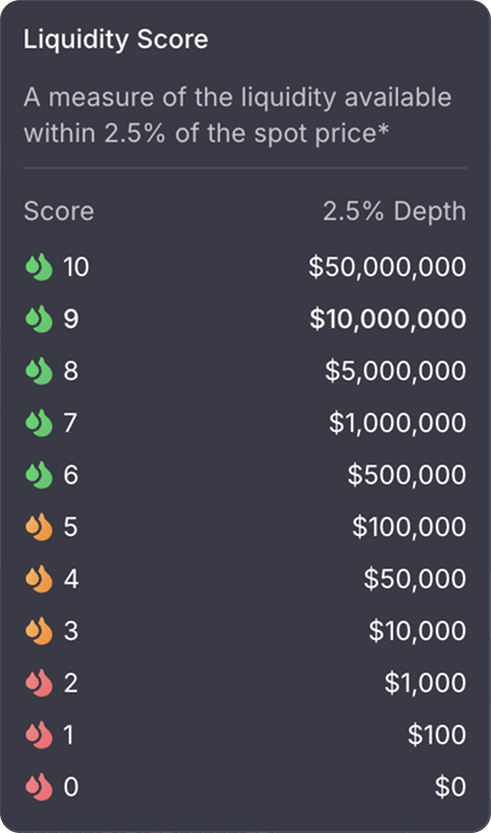
The Liquidity Score on Matcha measures depth in USD across all DEX pools at a given snapshot. It tells you how much you can swap with less than 2.5% price impact. Filter the Discovery Table by chain to compare liquidity across networks and pick the one where your trade gets the cleanest execution.
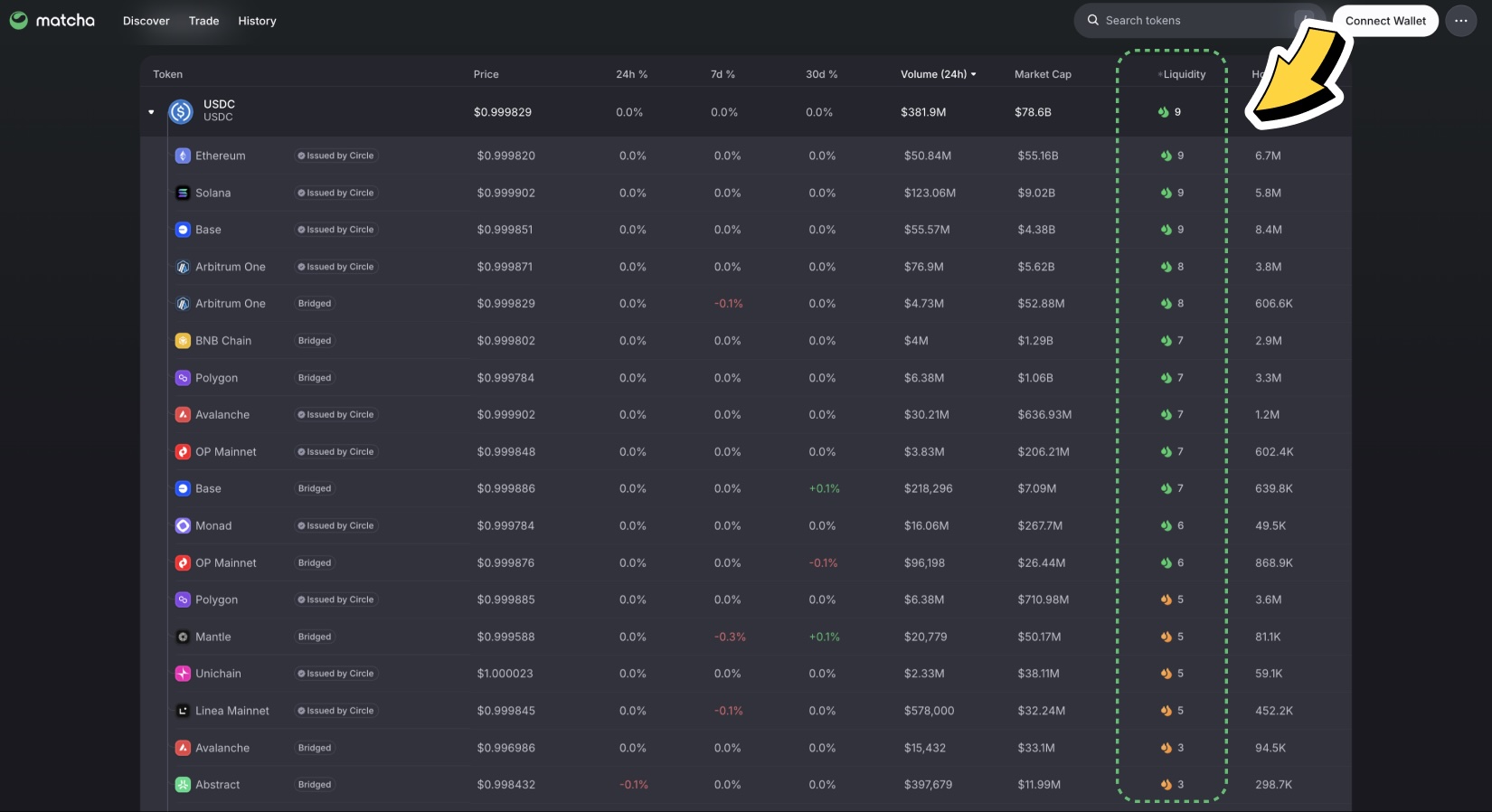
The check: What's the Liquidity Score on the chain you're planning to buy on? Is there a chain where the same token has significantly deeper pools? For your trade size, will the liquidity support a clean exit?
Check 4: does the token design make sense for the category?
Different categories call for different questions.
For currencies, issuer and backing are everything. USDC is issued by Circle with monthly third-party attestations. Algorithmic stablecoins rely on mechanism design rather than reserves.
Similar logic applies to commodities: is a gold-backed asset actually backed 1:1 by physical gold? Who is the custodian? PAXG is issued by Paxos under OCC regulation. XAUT is issued by Tether with gold in Swiss vaults.
LSTs come down to yield versus risk. stETH from Lido has the deepest DeFi integrations, JitoSOL captures MEV rewards on Solana, and rETH from Rocket Pool prioritizes decentralization. They all earn staking yield, but the risk profiles and liquidity depths differ.
What about tokenized stocks? Confirm the issuer (xStocks are issued by Backed, a Swiss-regulated company), understand these are typically economic exposure tokens rather than full shareholder rights, and check liquidity.
Launchpad tokens are a different situation entirely. Assets from Virtuals, Clanker, or Bankr can appear within minutes of launch. The holder count will be low, the liquidity will be thin, and the risk is high. The same signals (holders, liquidity, security flags) help you decide whether "early" means opportunity or trap.
The check: For this category, do the fundamentals match what a legitimate version should look like? Does the issuer, backing, yield source, or launch mechanism check out? Compare tokens from each category side by side using the various category tables on Matcha for best results.
Check 5: can I actually exit this position later?
Before you buy anything, imagine selling it. Is there enough liquidity for you to get out?
A high market cap paired with a low Liquidity Score is a warning sign that could mean most of the supply is locked, vesting, or held by insiders. The stated value looks big, but there's no real depth for you to sell into. This mismatch between market cap and actual tradeable liquidity is one of the most common traps in crypto, and it's invisible unless you use an app that checks.
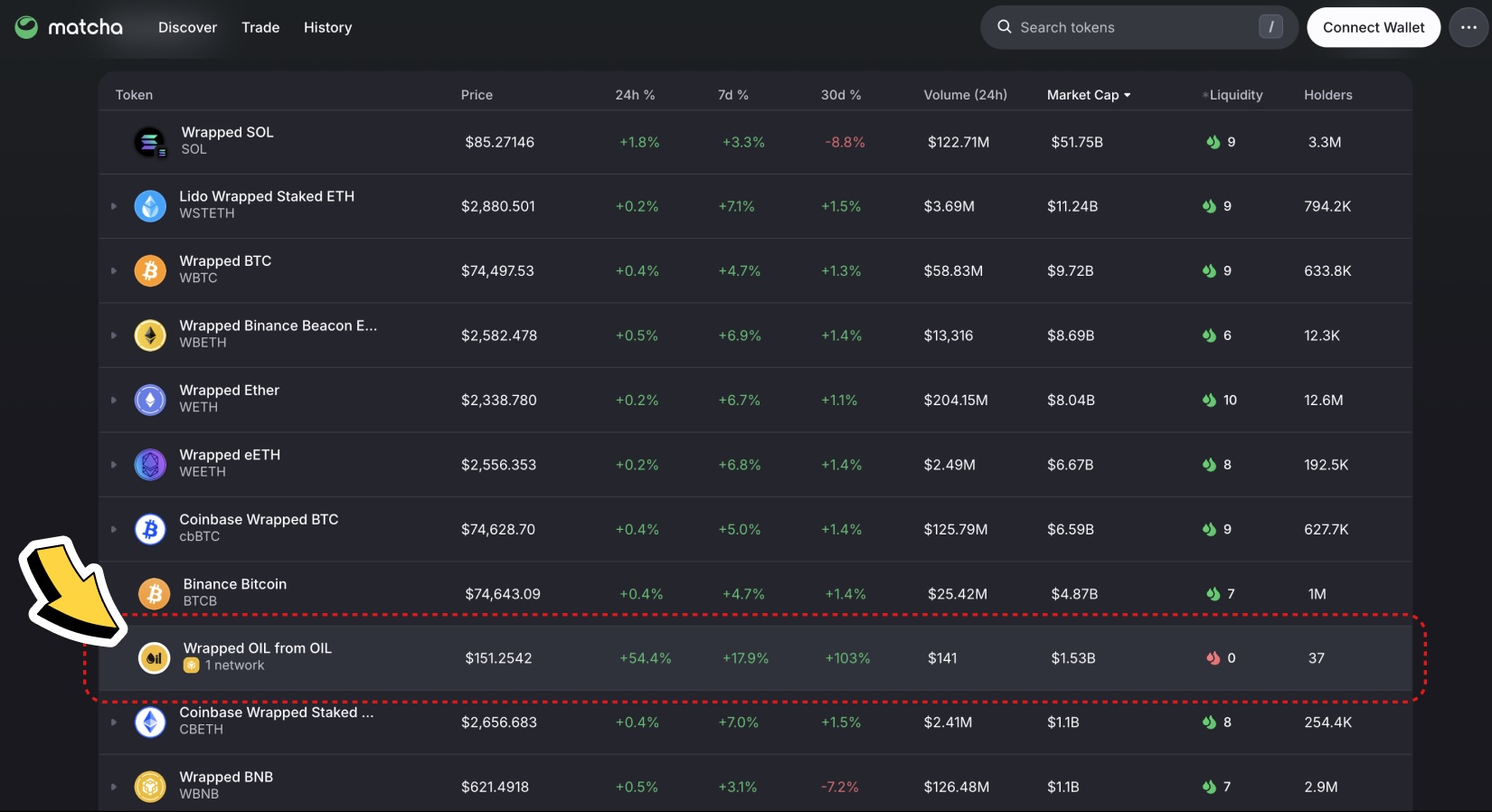
The check: Compare the market cap against the Liquidity Score. If the Liquidity Score is near zero, ask why. Could you sell your position at roughly the price you bought it, or would you move the market against yourself trying to exit?
Why context matters
Matcha shows you 45+ million tokens across 17 chains. Anyone can launch a token in under a minute and tens of thousands of new tokens are created every day across major chains. The volume keeps growing, especially from AI agent launchpads and social token platforms, and so does the number of counterfeits riding every trending narrative.
In this hyper-productive environment, you need all the tools in one place. A Discovery Table for browsing and comparing; token pages for fundamentals, charts, liquidity, and security signals; and a swap interface for executing.
Matcha equips you to do it all without leaving the site: Find a token. Verify it's real. Check its fundamentals. Confirm there’s liquidity. Trade.
Open the Discovery Table on Matcha →
Frequently asked questions
What is a Liquidity Score on Matcha?
Liquidity Scores measure a token's depth in USD across all DEX pools at a snapshot in time, telling you how much you can swap with less than 2.5% price impact. A higher score means you’ll get better execution on larger trades. The score updates regularly and can change fast.
How do I know if a token is a counterfeit?
Check three things: the contract address (does it match the official project source?), the holder count (counterfeits typically have very few holders), and the Liquidity Score (fakes rarely have meaningful liquidity). Matcha also flags risky smart contract functions on token pages.
Can I paste a contract address into Matcha?
Yes. Paste it directly into the search bar. If a DEX pool exists for that token across any of the 17 supported chains, you'll find it instantly.
How many tokens does Matcha support?
Over 45 million across 17 chains. Any asset with an existing DEX liquidity pool can be searched and traded without a listing process.
How fast does Matcha list new tokens?
New assets are indexed within minutes of their first DEX pool being created. No manual listing, no application. If liquidity exists on a supported chain, it's searchable and tradeable.
Dive deeper by category
Each of these guides explores a specific token category in detail:
- Commodities: Gold-backed crypto tokens: how to compare and buy tokenized gold
- Stocks: xStocks explained: trade Tesla, Nvidia, and Apple onchain 24/7
- LSTs: Liquid staking tokens: compare LSTs by yield, liquidity, and holders
- Currencies: Stablecoins in 2026: how to compare by issuer, backing, and liquidity
- Launchpads: How to find new crypto tokens before they pump (without getting rugged)
- Safety: How to check if a crypto token is safe before you buy


